USB Power Hub
One 65 W USB-C charger in, eight regulated 5 V outputs out. Power every OMGrow device in the room from a single wall socket instead of a tangle of phone chargers.
Two 2.4 A USB-C ports for pH Dosers, whose pumps draw more than a sensor does, and six 1 A USB-A ports for everything else: sensors, controllers, the Gateway. Every port has its own current limit, so a fault on one device can't take the others down.
No firmware, no app, nothing to configure. Plug it in and it works.
Pay by card, Apple Pay or Google Pay. Free shipping. Prices in AUD.
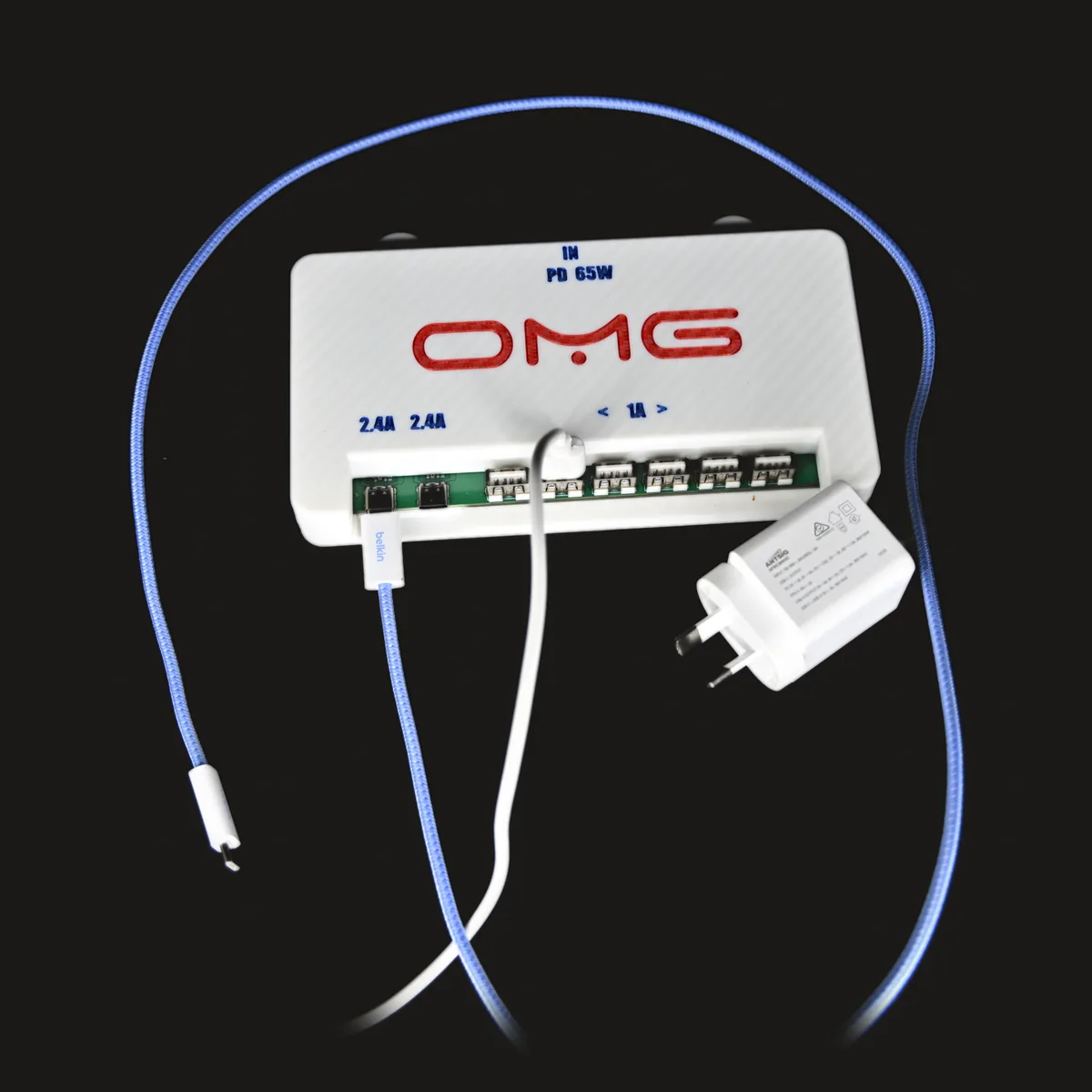
Eight Ports, Sized to the Devices
Every OMGrow device runs from 5 V USB, on purpose: lose a power supply and any phone charger will do. A room full of them, though, means a room full of chargers and a power board you'd rather not look at.
The hub replaces all of them. The two USB-C ports are rated at 2.4 A each for the pH Doser, whose peristaltic pumps are the hungriest load in the range. The six USB-A ports deliver 1 A each, which is more than any sensor, controller or the Gateway will ask for.
All eight at full load add up to just under 55 W, comfortably inside what a 65 W charger provides, so there's no juggling which device gets plugged in where.
What Plugs In Where
Inside the Box
-
→
USB-C PD negotiation
A dedicated Power Delivery controller asks the charger for its high-voltage profile, so the full 65 W is available rather than the 15 W a plain 5 V cable would carry.
-
→
Two independent 5 V regulators
Two buck converters split the load, each with its own filtering, so pump current on one bank doesn't ripple through to the sensors on the other.
-
→
A current limit on every port
Each output has its own electronic switch with over-current, short-circuit and thermal protection. A shorted cable takes out that port, not the room.
-
→
Input surge protection
A transient suppressor on the input clamps spikes from the charger or the mains before they reach anything downstream.
-
→
Two status lights
One confirms the charger negotiated properly, one confirms 5 V is present. If a device is dead, you know in a glance whether the hub is the reason.
Not Just a Splitter
A cheap USB splitter parallels its ports onto one 5 V rail and hopes. One shorted lead and everything on it goes dark; one noisy load and every sensor on the rail sees the ripple.
This one is built the way a piece of grow room infrastructure should be, because the devices hanging off it are the ones keeping your pH, your CO₂ and your climate where they belong. Each port is isolated by its own current-limited switch, the regulators are split into two banks, and the input is protected against the charger doing something unexpected.
Any 65 W USB-C PD charger works, including the one that came with your laptop. We don't bundle one because you very likely already own it, and shipping a charger you don't need is a cost you shouldn't pay.
Printed in PLA. Built to Be Repaired.
The enclosure is 3D printed in PLA, a bioplastic made from plant starch. It's mostly polylactic acid, with a small fraction of polymer impact modifiers blended in so it prints cleanly and stands up to years in a warm, humid room. Those modifiers are polymers, not the free-floating phthalate plasticisers that make up to 40 percent of flexible PVC, and there are no bisphenols because PLA isn't a polycarbonate.
Every device carries a five-year warranty, and every part in it is user-replaceable. We sell the circuit boards, the printed cases and the individual parts, so if something does fail outside the warranty you fix it cheaply instead of replacing the device. We'd like you to still be running this in ten years.
Why we build from bioplasticOne charger. Every device.
$60, 2 week lead time, shipping worldwide. Charger not included.