Smart Relay
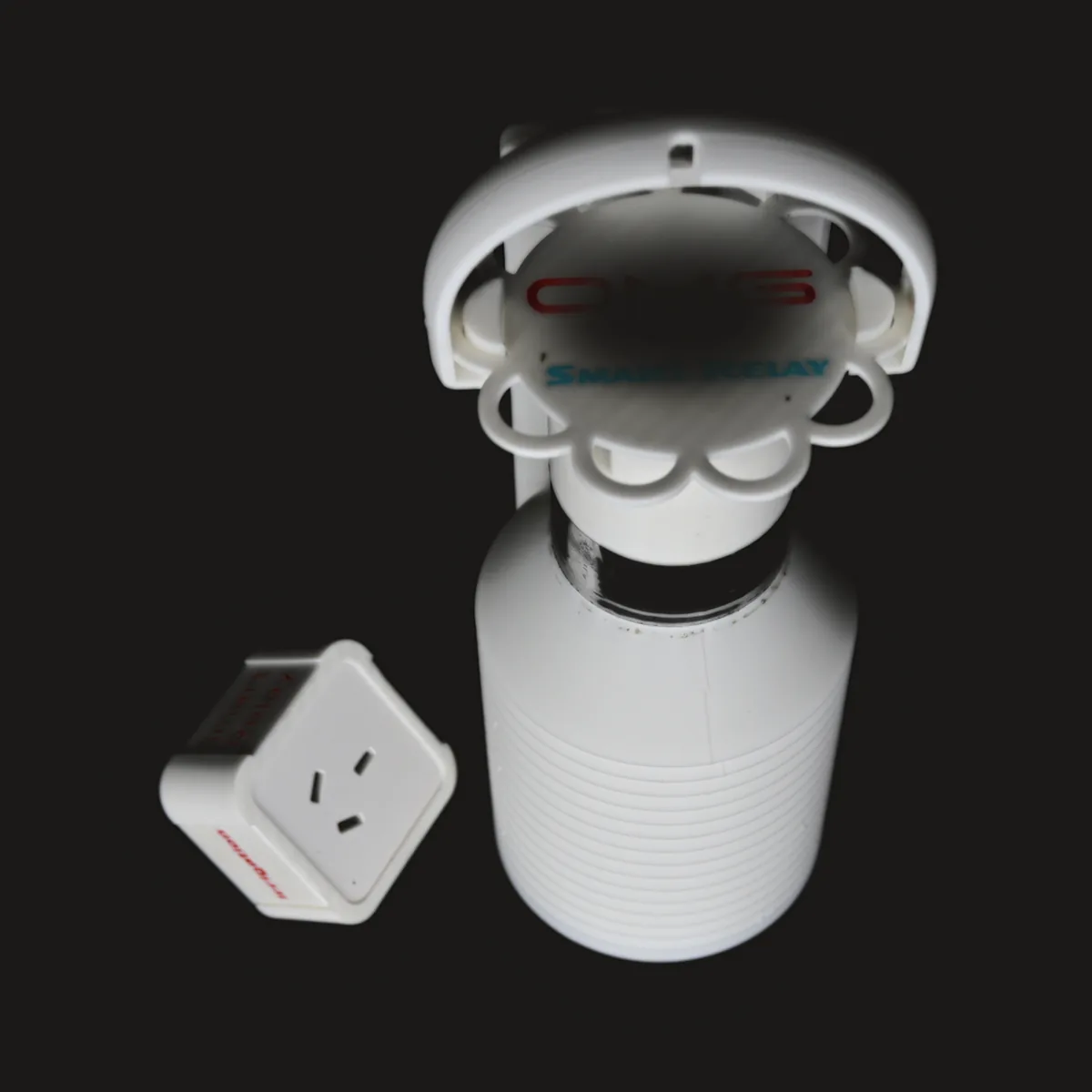
A sensing controller and a paired mains socket. Plug the socket into the wall, plug your dehumidifier, humidifier, heater, fan or pump into the socket, and tell the controller what the room should look like.
The controller carries a Sensirion SHT41 and an ambient light sensor in a Stevenson screen housing, so it switches on what the room is actually doing. Humidity and temperature thresholds, lights-on and lights-off following, a daily window, or an irrigation schedule with up to 32 events a day.
The socket obeys this one controller and nothing else, and switches itself off if the controller goes quiet.
Pay by card, Apple Pay or Google Pay. Free shipping. Prices in AUD.
Tell It What the Room Should Be
Pick the job the socket is doing and the controller runs the right logic for it, off its own sensors, on its own processor.
Humidity
Set a target and a band. A dehumidifier switches on above the band and off below it; a humidifier does the reverse. The band stops it chattering around the setpoint.
Temperature
The same threshold logic for a heater, a cooler, or an exhaust fan that only needs to run when the room is over temperature.
Follow the Lights
The onboard light sensor knows when your lights are on. Run a circulation fan with the lights, or a humidifier only in the dark, with no clock to set and no schedule to keep in step.
Schedule
A simple daily on/off window, midnight crossings included. Or the irrigation schedule: up to 32 timed events a day, each with its own duration, drawn on a 24-hour timeline in the app.
Built for Irrigation Too
Feed pumps want short, frequent events rather than one long window, so the irrigation schedule gives you up to 32 events a day, each with a start time and a run time down to the second. Drag them around on the timeline in the app, save the pattern as a preset, and apply it to the next room.
When it's time to flush, the flush cycle takes over: the pump pulses on and off at intervals you choose, for as long as you choose, then hands control back to the schedule. It never saves itself as the new normal, so a flush can't accidentally become your feed program.
Once the clock is set, schedules run on the controller itself and carry on through an internet outage. Because the controller also reads temperature and humidity, it's one more monitoring point in the room while it does it.
Appliance Roles
Pick what's plugged in and the app shows only the settings that make sense for it.
Label the Socket, Not the Cable
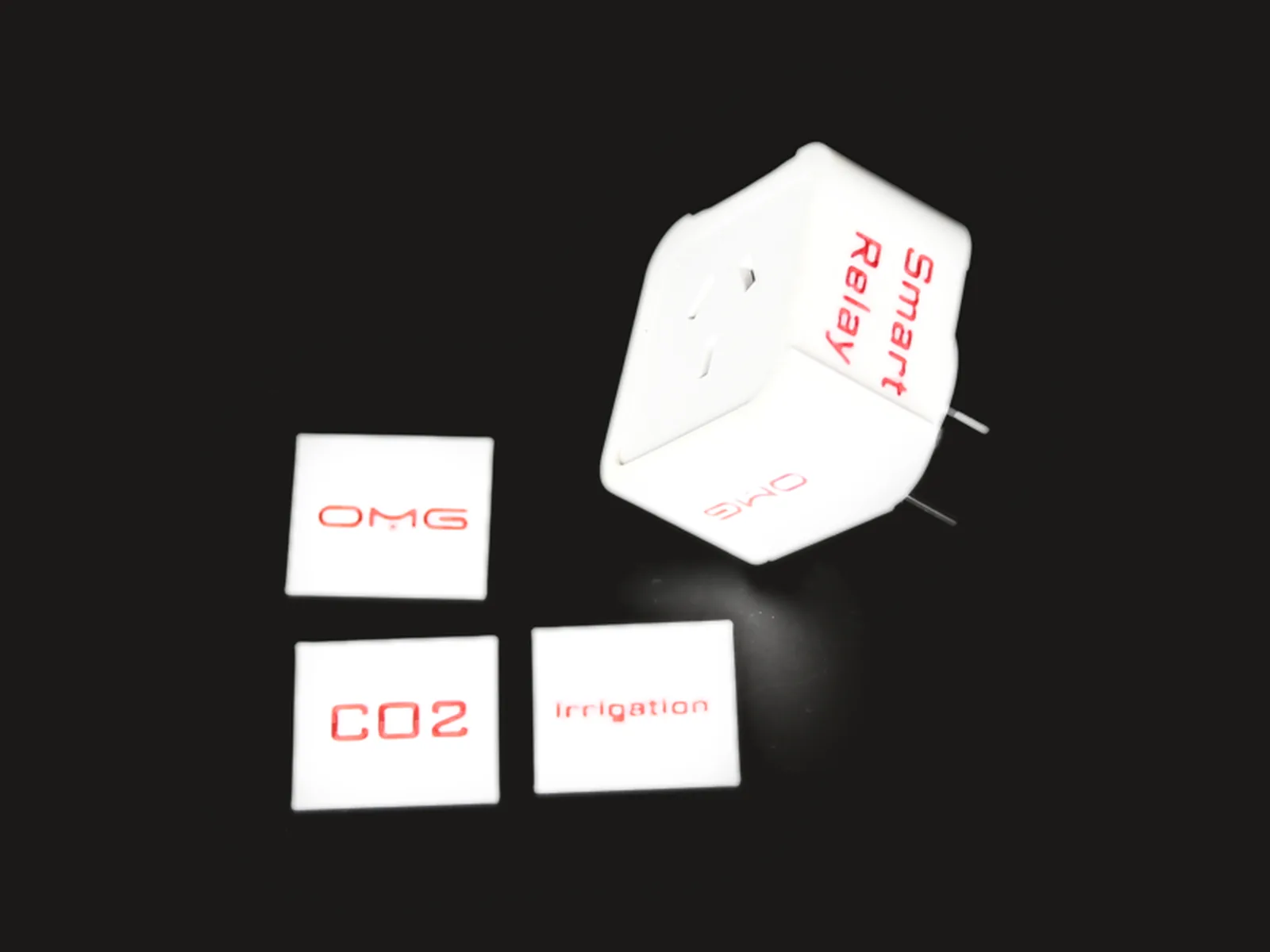
A power board full of identical white plugs is how the dehumidifier gets unplugged instead of the fan. Each socket ships with a set of interchangeable role indicator cards that slide into the housing, so what it's switching is printed on the front where you can read it.
Change what's plugged in, swap the card. Nothing to peel off, no marker pen, and no guessing in a dim room at 3 AM.
The card also tells you which system a socket belongs to. The CO₂ Controller's socket runs different firmware with a hard injection ceiling, and the two are never interchangeable.
The Socket Answers to One Device
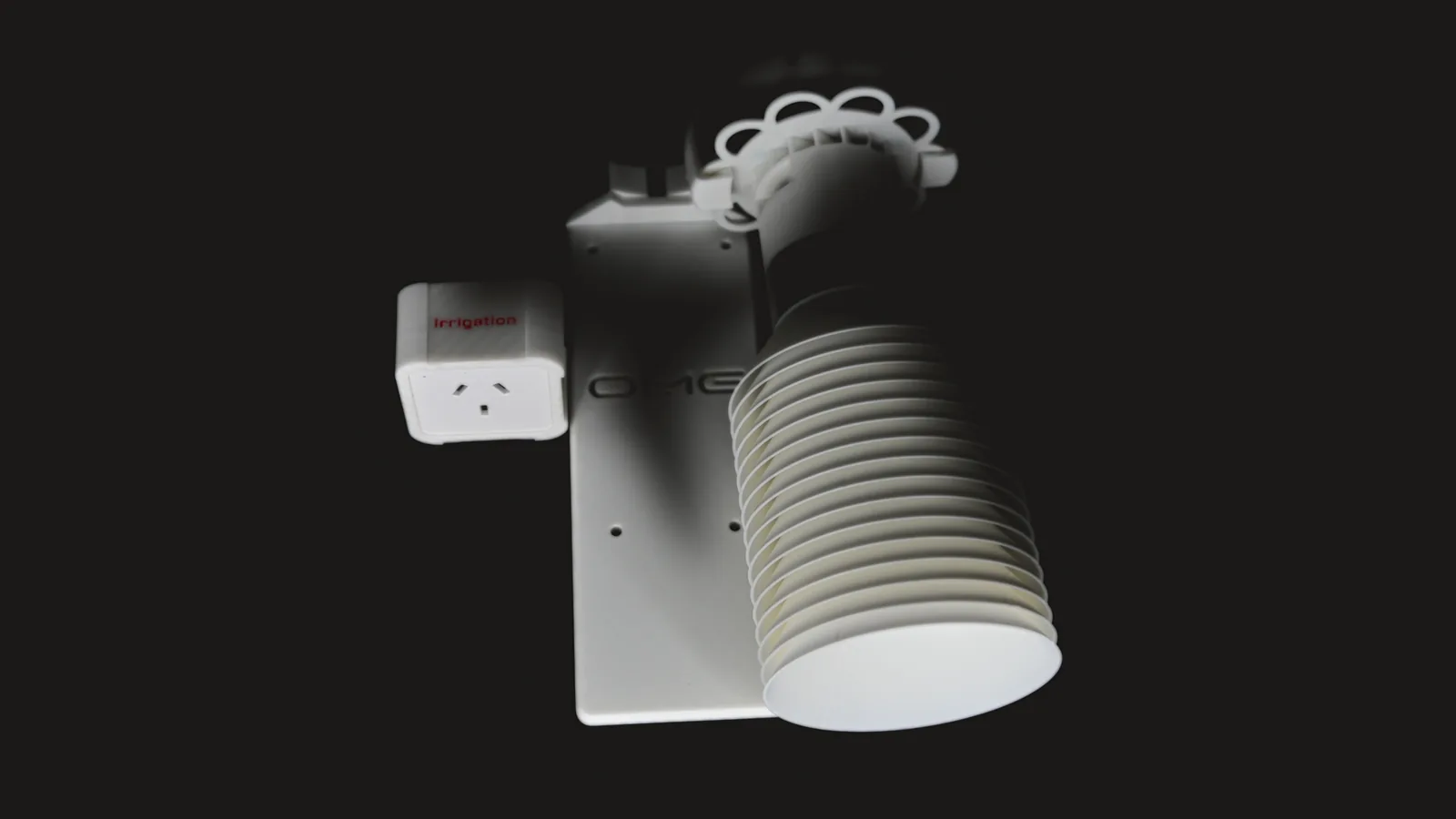
A mains socket that can be told what to do by anything on the network is a socket that will eventually be told what to do by the wrong thing. So this one is paired to its controller by hardware address, and it discards every packet that doesn't come from it.
New sockets are only adopted during a pairing window you open deliberately, from the app. Outside that window there's nothing for a neighbour's identical hardware, or a second OMGrow system on the same bench, to talk to.
The link is a direct device-to-device radio protocol, chosen for stability above all else. There's no router in the path, no message broker, and no server. Your commands from the app reach the socket by going to its controller first, which then talks to the socket over that private link.
What the Socket Won't Do
-
✕
Join your WiFi
Not in normal operation. WiFi exists only in a firmware update mode you activate with a physical button press.
-
✕
Depend on the internet
Nothing about its switching behaviour touches a cloud service. Your connection can be down for a week and it carries on.
-
✕
Take orders from anything else
Wrong hardware address, ignored. There is no override for this.
-
✕
Stay on when it's lost contact
Silence is treated as a fault, not as permission to continue.
Fail-Safe Behaviour
The controller tells the socket every five seconds what state the relay should be in. A socket that's somehow out of step corrects itself on the next message.
Twenty seconds without a heartbeat and the socket opens the relay on its own initiative. It doesn't need the controller to be working to do this.
If the controller loses the socket, it commands off. If it loses its sensors while in a sensor-driven mode, it commands off. Schedules and manual control carry on regardless.
Four hours on and the reading hasn't moved towards target? You get an alert. Probably an empty humidifier, a tripped dehumidifier, or an open door.
Safety That Doesn't Trust the Controller
Most safety logic lives in the brain of the system, which is a problem, because the brain is the thing most likely to crash. If the controller is also the only thing that can stop the pump, a hung controller means a pump that runs until the reservoir is on the floor.
So the last limit lives in the socket. It counts its own seconds and opens its own relay. It doesn't need the controller to be working, doesn't need it to be honest, and doesn't need it to be powered on. Silence is a stop signal, not an absence of one.
There is deliberately no ceiling on how long a single switch-on can last. Dehumidifiers and heaters run for hours, and a socket that cut them off would be a hazard of its own. The CO₂ Controller's socket is different: it carries a hard 15-second injection limit, which is why the two sockets run different firmware and are not interchangeable.
Hardware & Connectivity
The Controller
- • Sensirion SHT41 temperature and humidity sensor, ±0.2°C and ±2% RH, in a louvred Stevenson screen housing that reads true under grow lights
- • Ambient light sensor for lights-on and lights-off following, and to keep its own indicator dark during your night cycle
- • Dual-core 240 MHz microcontroller; schedules, setpoints and pairing live in non-volatile memory and survive a power cut, with the clock resyncing over the network when power returns
- • 2.4 GHz WiFi for remote access; Bluetooth LE and a local web interface for setup and control with no network at all
- • Loses WiFi? It reboots and retries until the router is back. It never drops into setup mode on its own.
- • Standard 5V USB power — any phone charger works as a replacement
The Socket
- • Plug-in Australian mains socket; your appliance plugs straight into it
- • Paired by hardware address to one controller, adopted only during a pairing window you open from the app
- • 20-second silence watchdog and heartbeat self-correction, enforced in the socket itself
- • Never joins your WiFi in normal use; firmware updates are a button-triggered local mode
- • Add more sockets to the same room by pairing each to its own controller
- • Slide-in role indicator cards included, so the socket says what it's switching
Access From Anywhere
- • TLS-encrypted connection to our servers — monitor and adjust from any phone, tablet or computer
- • Local-first at home — on the same network the device answers directly, without a round trip through the internet
- • Relay history and runtime charts included, free, with no subscription
- • In-app and push alerts included, along with SMS and voice call alerts — currently at no charge, prepaid rather than a subscription if that changes, and dormant until you choose to enter a phone number
- • No subscriptions, no monthly fees. One purchase, lifetime access.
Printed in PLA. Built to Be Repaired.
The controller housing and socket case is 3D printed in PLA, a bioplastic made from plant starch. It's mostly polylactic acid, with a small fraction of polymer impact modifiers blended in so it prints cleanly and stands up to years in a warm, humid room. Those modifiers are polymers, not the free-floating phthalate plasticisers that make up to 40 percent of flexible PVC, and there are no bisphenols because PLA isn't a polycarbonate.
Every device carries a five-year warranty, and every part in it is user-replaceable. We sell the circuit boards, the printed cases and the individual parts, so if something does fail outside the warranty you fix it cheaply instead of replacing the device. We'd like you to still be running this in ten years.
Why we build from bioplasticSwitching you can reason about
$200 for the controller and its paired socket. 2 week lead time, shipping worldwide.