CO₂ Controller
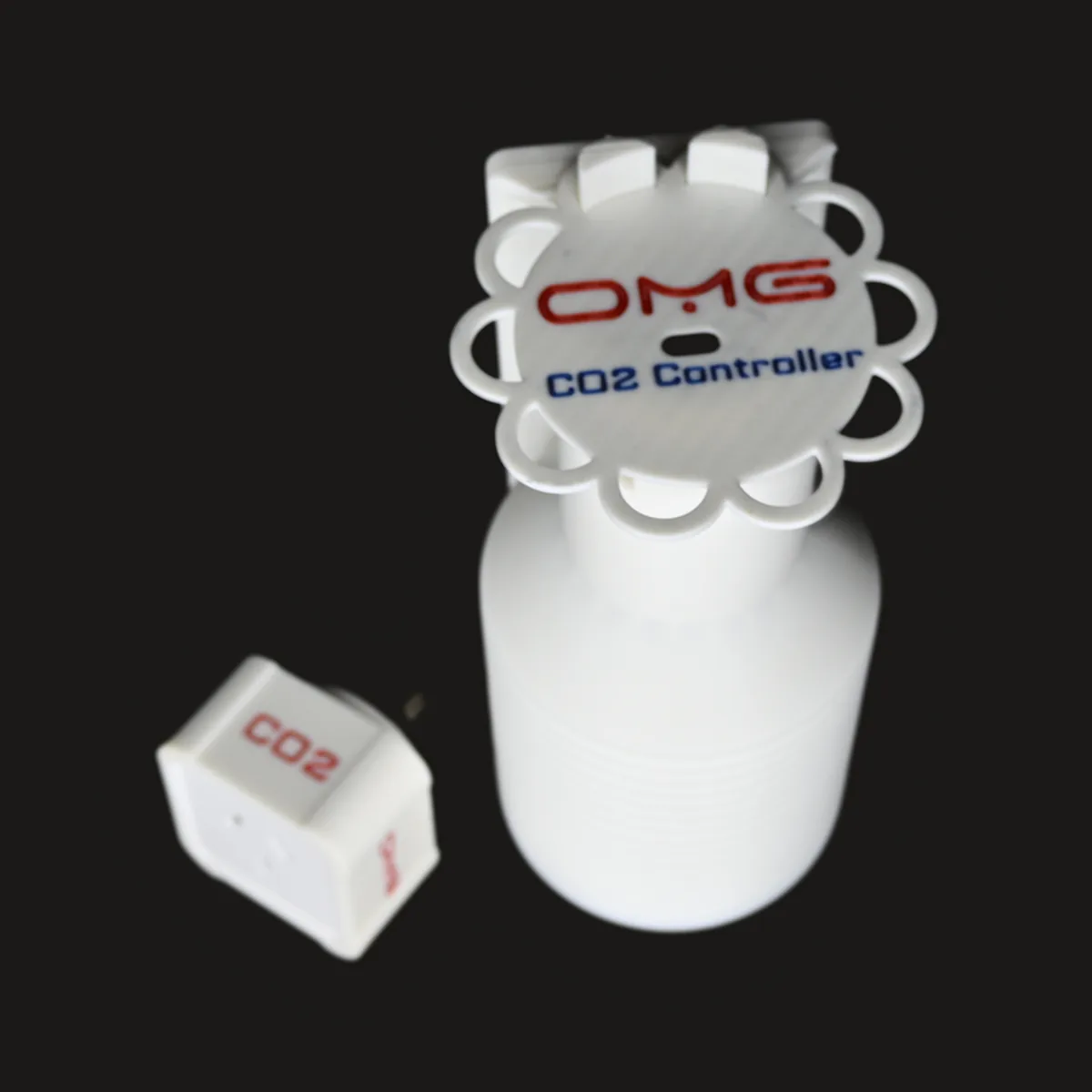
An all-in-one controller. Photoacoustic CO₂, temperature, humidity and light sensing are all on the board, inside a Stevenson screen housing that sits in the room where the reading actually matters.
Five independent safety layers, the last two of them enforced by the socket itself rather than by the controller asking nicely.
Standard 5V USB-C power — any phone charger works as a replacement.
Pay by card, Apple Pay or Google Pay. Free shipping. Prices in AUD.
No Internet in the Control Loop
The controller decides when to inject. The socket switches the valve. The link between them is a direct radio link that talks device to device — no router, no message broker, and no cloud service sitting in the middle of a decision that has to happen in seconds. It was chosen for stability rather than for range or throughput, because its entire job is to do what a cable would do without being a cable, and to give up nothing in the trade.
The practical consequence is that the part of this system capable of doing harm doesn't depend on your internet. If your connection drops out, your modem reboots, or our servers go offline, CO₂ control carries on exactly as before. You lose remote monitoring until it comes back. You don't lose the control loop.
The socket only accepts commands from the controller it's paired with, filtered by hardware address. It ignores everything else transmitting nearby — including a second OMGrow socket sitting on the same bench.
What Happens When Something Fails
-
→
Your internet drops
Injection control is unaffected. Remote access resumes when the connection does.
-
→
The controller loses power
The socket stops hearing heartbeats and drops the relay after 20 seconds, on its own
-
→
The controller hangs mid-injection
The socket's own 15 second ceiling ends the pulse whether or not anyone tells it to
-
→
A sensor starts misreading
The health check catches it and forces injection off rather than acting on bad data
Two Devices, One Job
The controller measures and decides. The socket switches. There's nothing else to buy and nothing else to configure — both are in the box, paired before they ship.
The Controller
Sensing and decision-making in one unit. It reads the room directly, runs the injection logic, and holds the socket to a schedule of short pulses rather than long open periods.
- • Sensirion SCD41 photoacoustic CO₂
- • Sensirion SHT41 temperature and humidity
- • Ambient light sensing for dark cycle checks
- • Stevenson screen housing, USB-C powered
The CO₂ Socket
Switches your solenoid valve. It takes orders from one controller and no other, and it holds two safety limits of its own that the controller cannot override.
- • Paired to one controller by hardware address
- • Drops the relay after 20 seconds of silence
- • Hard 15 second ceiling on any injection
- • Never joins your WiFi in normal use
Runs CO₂-specific firmware with the injection ceiling built in. Not interchangeable with the Smart Relay's socket.
Because sensing is onboard, put the controller where you want the reading taken — at canopy height, in the problem corner, wherever the number matters. There's no separate sensor to site and no sensor cable to run. The SHT41 fitted here is a discrete sensor rather than the one inside the CO₂ chip, so this unit doubles as a full temperature and humidity monitoring point in its own right.
Five Independent Safety Layers
If the readings stop making sense, injection is forced off. Acting on a broken sensor is worse than not acting.
A stop command is retried until the socket confirms it, rather than sent once and assumed to have landed
Every heartbeat carries the relay state the controller intends, so a socket that has drifted out of step fixes itself on the next message
Twenty seconds without a heartbeat and the socket cuts the relay by itself, with no involvement from the controller
The socket enforces a fifteen second ceiling on any single injection, regardless of what the controller asks for
CO₂ Is Not a Toy
Carbon dioxide is invisible and odourless. At concentrations above 5,000 ppm it causes headaches and dizziness. Above 40,000 ppm it can be fatal within minutes. A regulator failure or stuck solenoid can create dangerous conditions faster than you'd expect.
There are five independent layers of protection here, and the detail that matters most is where the last two live. Layers four and five run inside the socket, not the controller. A controller that crashes, hangs, loses power, or simply gets the arithmetic wrong cannot hold your valve open, because the device actually holding the valve open is counting its own seconds and will stop on its own.
Every failure path we could think of ends in the same state: valve shut. Not a warning, not a degraded mode, not a best guess at carrying on. Shut. For a gas you can't see or smell, which works by displacing the air you're breathing, that's the only sensible default.
Alerts That Actually Reach You
In-app and push notifications are included. They're also the easiest thing in the world to ignore, so for the alerts that matter there are two that are much harder to sleep through — both currently switched on at no charge.
SMS
A text message the moment a threshold is breached. Arrives whether or not you have the app open.
Voice Call
For critical alerts, an automated phone call — the one thing that reliably gets you out of bed at 3am.
In-App and Push
Included with every device, no add-on required. Set your own thresholds per sensor.
SMS and Voice Alerts
Switched on for every device at no charge at the moment. Each message and call costs us money to deliver, so this will eventually become a prepaid add-on: $20 buys a year, purchased from the website like anything else we sell, and your account is enabled automatically. No subscription, no auto-renewal, no card kept on file — and if the credit lapses, the device carries on doing its job with in-app alerts.
This is also the one optional third-party service in the system, and it's opt-in by the most literal mechanism there is: it doesn't exist until you type a phone number into the alerts page. Until you do, no third party ever sees your number. After you do, the delivery service receives exactly what it needs to do its job — a phone number and the message to send — and nothing else.
Hardware & Connectivity
Processing & Wireless
- • Dual-core 240 MHz microcontroller with 8 MB PSRAM and 16 MB flash — headroom for real-time control, safety monitoring, and OTA firmware updates
- • 2.4 GHz WiFi (802.11 b/g/n) — better range and wall penetration than 5 GHz, which is what a grow room actually needs
- • Direct peer-to-peer radio link to the socket, running independently of your router and your internet
- • Bluetooth LE for direct local control — set up and adjust the device with no network at all
- • mDNS discovery and a local web interface — find it by name on your own network and control it without touching the cloud
- • Standard 5V USB-C power — any phone charger works as a replacement
- • Dark room aware — when the sensors report lights-off, indicator LEDs stay off completely, so the equipment can't pollute your dark cycle
Access From Anywhere
- • TLS-encrypted connection — monitor and control from any phone, tablet, or computer worldwide
- • Local-first when you're home — on the same network, the device responds directly
- • Encrypted SMS and voice call alerts — enter your phone number, set thresholds, get notified immediately
- • Historical graphs included — 48 hours of real-time data and 7 days of aggregated data, free, no subscription
- • Web app works on any browser. Native Android and iOS apps available.
- • No subscriptions. No monthly fees. One purchase, lifetime access.
Printed in PLA. Built to Be Repaired.
The housing is 3D printed in PLA, a bioplastic made from plant starch. It's mostly polylactic acid, with a small fraction of polymer impact modifiers blended in so it prints cleanly and stands up to years in a warm, humid room. Those modifiers are polymers, not the free-floating phthalate plasticisers that make up to 40 percent of flexible PVC, and there are no bisphenols because PLA isn't a polycarbonate.
Every device carries a five-year warranty, and every part in it is user-replaceable. We sell the circuit boards, the printed cases and the individual parts, so if something does fail outside the warranty you fix it cheaply instead of replacing the device. We'd like you to still be running this in ten years.
Why we build from bioplasticReady for proper CO₂ control?
Controller and CO₂ Socket, paired and ready. 2 week lead time, shipping worldwide.